
How many restrooms does a race actually need?
Start with runner count and finish-line dwell time, not just distance. A field of 500 runners moving through a finish chute in under an hour creates a short, sharp spike, different from a course with staggered waves. OSHA 1926.51(c) sets construction ratios, not race-day ones, but race organizers in Lodi still use it as a rough baseline: one unit per 20 to 40 people for a few hours of heavy use works better than one per 40 stretched over a full day. For a typical mid-size race, that means clusters of standard units at the start corral, a bank of them at the finish line, and smaller pods at aid stations along the route. Add a deluxe flushable unit or two near VIP or sponsor tents if the event has one. Bib pickup and packet tables draw crowds too, often an hour or two before the gun, so plan restroom placement around that surge, not just the race itself. Use our placement guide to figure out spacing along a route that loops through Lodi streets versus one that runs a straight point-to-point course. If you are unsure how many total units a specific headcount calls for, the how many porta potties do I need tool breaks it down by attendee count and event length.
Where should restrooms go along the course?
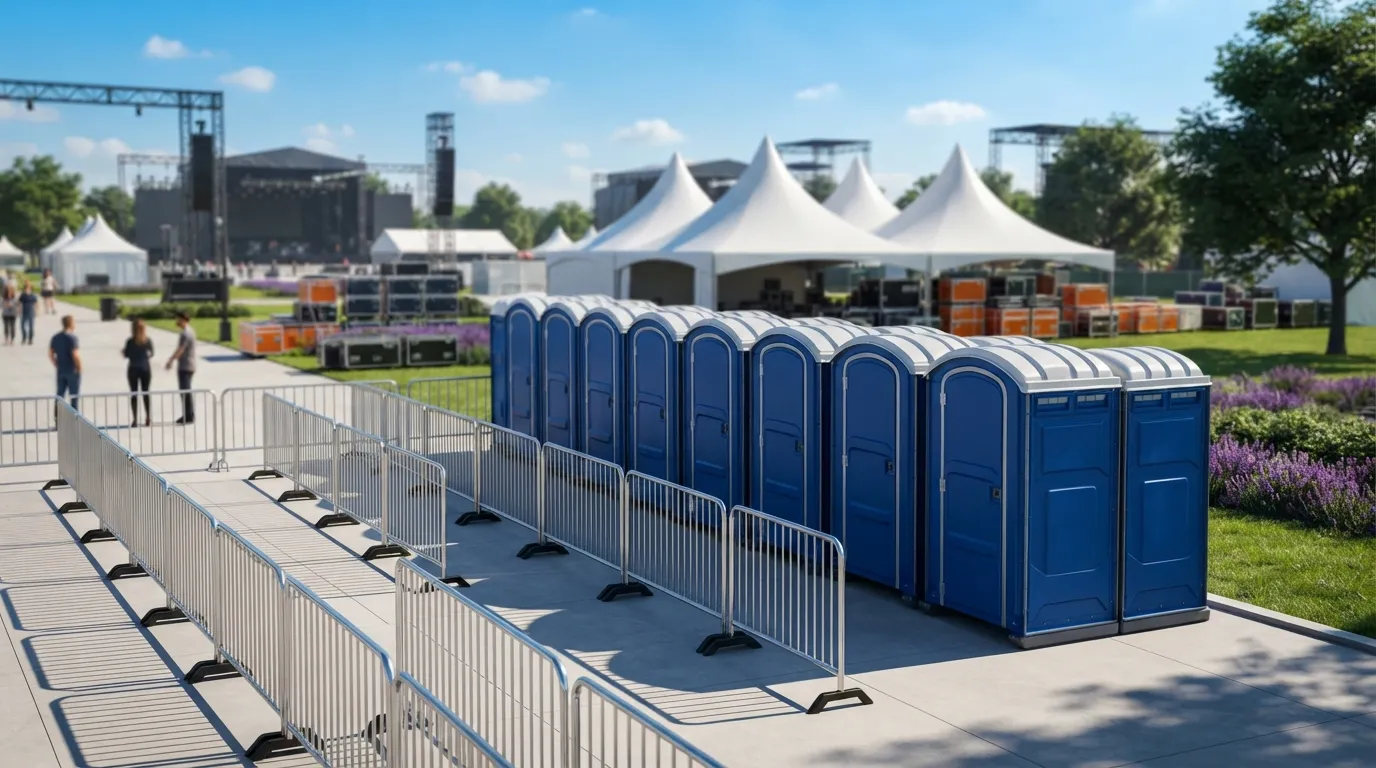
Aid stations are the natural anchor points because water and restrooms belong together. Ground clearance matters here too: a standard unit needs a stable, level pad, matching the same firm, slip-resistant surface principle in ADA Standards section 302.1, even where the unit itself isn't the accessible one. Keep a 36 inch clear path to every unit per ADA Standards section 403.5.1, which matters most at busy finish-line clusters where barricades and tents crowd the walkway. If your race uses temporary fencing or crowd control barriers to funnel runners at the finish, route that fencing so it doesn't block restroom access, a mistake we see often on tight downtown Lodi courses. Races that also run a food area or beer garden should look at a handwashing station rental near food service, since 29 CFR 1910.141(d)(2) calls for soap and towels, not just sanitizer, anywhere food is handled. If the course runs near Woodbridge, about 6.0 miles north of Lodi, or Acampo, 5.5 miles north, factor that drive time into your delivery window so units land the evening before, not race morning. Timing tents and finish-line AV often run on generators or a temporary power pole; brace any pole with guy wires or a stabilizing base plate so wind or a jostling crowd near the finish chute doesn't tip it, and keep cabling clear of the restroom walkway entirely.
Should we rent a restroom trailer instead of standard units?
For races with a paid VIP area, a sponsor village or a post-race party, a restroom trailer reads a lot better in photos than a row of blue boxes. A 2 stall trailer handles smaller finish-line VIP tents, while a 4 stall or 8 stall trailer suits a full festival-style finish area with vendors and awards. Trailers need a level pad and truck access similar to a roll-off delivery, which typically wants about 60 feet of straight clearance behind the vehicle. Budget accordingly: a weekend trailer rental runs higher than a single-day rate, so lock in your date early if the race falls on a busy fall weekend. For a straightforward course without a big finish-line festival, standard units or portable restrooms cost less and set up faster. Either way, request delivery early enough that your crew can walk the porta potty rental checklist before runners arrive. Races anywhere from Lodi to Victor, 6.0 miles east, or Galt, 13.4 miles north, use the same logic: match the restroom style to how long people linger at the finish, not just to runner count.
| unit | duration | typical |
|---|---|---|
| standard | event | $400 |
| ada | day | $230 |
| trailer | event | $3,500 |
How early should we book restrooms for race day?
Book as soon as your date and course are set, ideally 60 to 90 days out for larger races. Weekend demand spikes fast in Lodi, and popular fall race dates fill delivery slots early. Use request a quote to lock pricing before units run out.
Do we need an ADA unit at every aid station?
At least one accessible unit per cluster, per ADA Standards section 213.2. A cluster of six standard units at a busy aid station still only needs one ADA unit, but never zero. Spread clusters, not just totals, across the whole course.
How to brace a temporary power pole near the finish line?
Anchor it with a stable base plate or guy wires rated for the load, and keep it clear of runner paths and restroom walkways. Wind and crowd movement near a finish chute are the real risks, so secure cabling flat and taped down.
Can we get restrooms delivered the morning of the race?
Early morning delivery is tight but doable if booked in advance; most races prefer evening-before setup instead. Check emergency porta potty rental if a last-minute unit fails or an extra is needed.
What size dumpster do we need for race-day trash?
Depends on runner count and vendor volume; a 10 yard dumpster suits a small local race, while bigger events want a 20 yard. See dumpster sizes and dimensions to match volume to unit size.
Next step
Get a delivery date
Tell us the address, the dates and the headcount. We size the order and confirm the route.